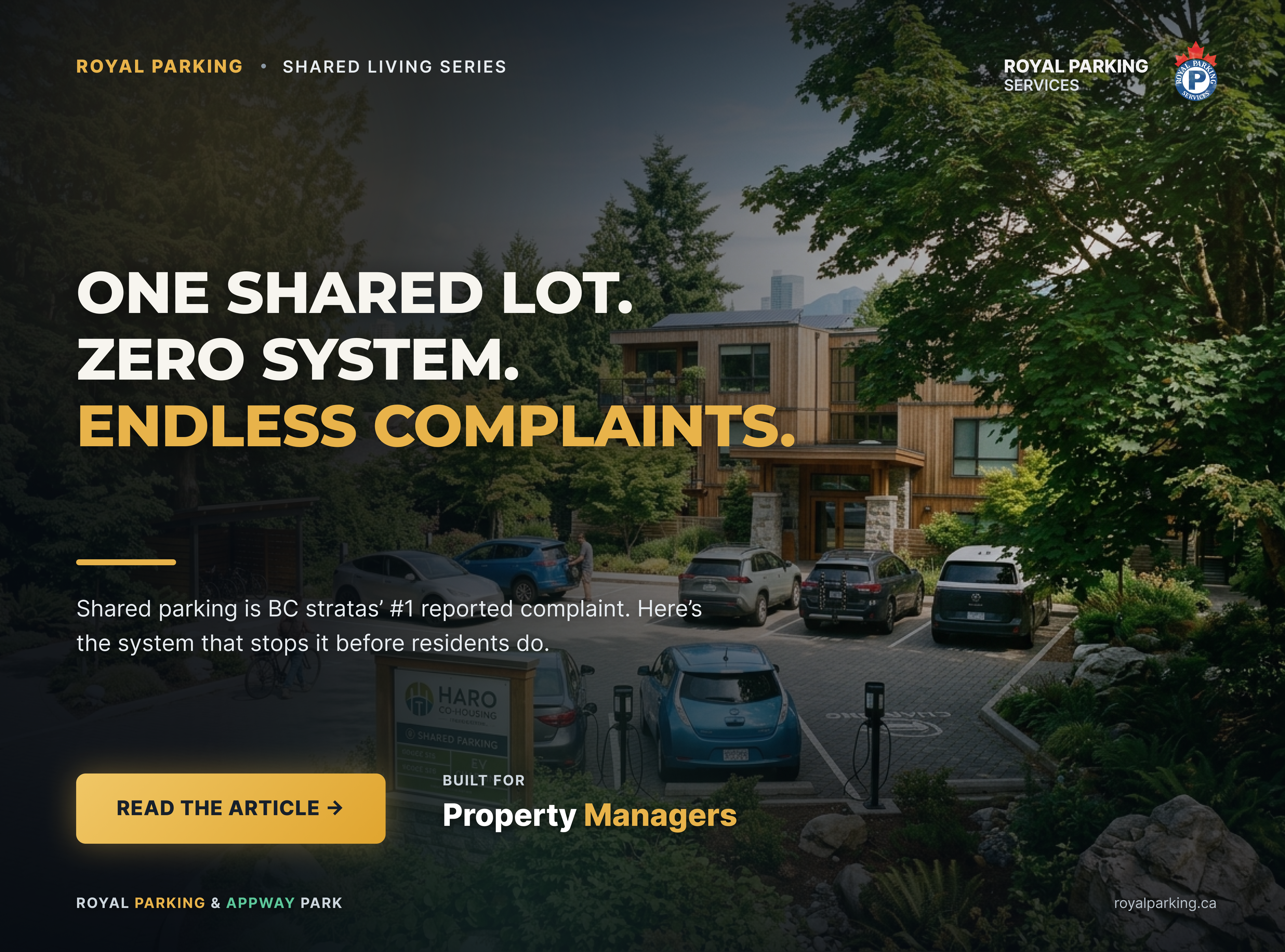
Imagine your dream home. Big backyard. Large driveway. A two-car garage all to yourself. That used to be the goal – your own little kingdom.
That goal is changing.
More and more people in British Columbia are choosing shared housing over private ownership: cohousing, co-ops, multi-generational properties. Private homes wrapped around common kitchens, gardens, parks and spaces and parking.
It’s great for community building. It’s great for affordability. But it creates one very practical problem: when nobody individually owns the driveway anymore who manages the parking lot?
These questions may seem like minor details. But getting them right will help ensure smooth function of the neighborhood. Fail to get these right and parking will become the thing that your neighbors quietly resent each other about.

Table of Contents
Why Parking Becomes The Pressure Point
A single-family home absorbs vehicle ownership quietly: one household, one driveway, one set of decisions nobody else has to weigh in on.
A shared community works differently. Now multiply that ownership across 20, 50, or 100 unrelated households on a single lot.
Add a rotating mix of visitors, deliveries, and contractors on top of that. The coordination problem grows fast — past what an informal, resident-run arrangement can reliably handle.
The research backs this up:
Most households have more than one vehicle. Canadian households own an average of nearly 1.5 vehicles each — a rate that climbed steadily for decades and has held essentially flat across British Columbia.3 In practice, that means single-car households are the exception, not the norm.
Roughly 40% of parking spaces sit unused, even at the busiest times. A study of 223 multi-family buildings in Washington, D.C. found that only about 60% of parking stalls were occupied on average, even at peak times.4 The spaces exist; without a system governing who uses which one and when, they simply aren’t available to the people who need them.
Parking is a reported bylaw issue. Access to shared parking is consistently identified as the single most reported bylaw issue in British Columbia stratas — ahead of noise, pets, and rental disputes — and common enough to fall squarely within the jurisdiction of BC’s Civil Resolution Tribunal.56

► If your community is scaling past a handful of households, it’s worth getting ahead of this before the complaints start. Talk to Royal Parking about a system built for shared living, or see how AppWay Park makes guest parking simple with mobile registration and pay. Go here
Meet Riverstone Cohousing
Riverstone is a composite example, built from the parking issues most commonly documented in shared-living and strata dispute records: a 28-unit cohousing community with a shared surface lot, a common house, and a mix of resident owners, long-term guests, and daily deliveries.
RIVERSTONE’S REALITY TODAY
- Potluck nights turn the lot into a free-for-all, with guests parked wherever there’s a gap.
- Delivery vans block the fire lane because there’s no marked loading zone.
- One resident has quietly become “the parking person,” fielding complaints nobody assigned to them.
- Out-of-town guests have no way to register a car for a multi-day stay.
WHAT THE COMMUNITY WISHES FOR
- A lot that explains itself, so no single neighbour has to.
- A simple way for guests to register and pay without calling anyone.
- Enforcement that doesn’t put a resident in an awkward, face-to-face conflict.
- A parking area that looks as cared-for as the gardens and common house.
None of this requires new house rules. It requires the existing expectations to be visible, consistent, and backed by an actual system — not one more thing residents have to negotiate among themselves.

▶ Sound like your community’s week? A parking assessment can take it off the table entirely. See how Royal Parking can help, and how AppWay Park makes guest registration effortless for residents. Go here.
What Unmanaged Shared Parking Actually Costs A Community
Unmanaged shared parking rarely shows up as one big blow-up. It shows up as friction spread across a dozen small interactions:
Eroded trust. Ambiguous rules turn into guesswork, and guesswork turns into residents feeling like other neighbours are getting away with something.
An unpaid “parking warden.” Without a real system, one resident inevitably absorbs the job of tracking, reminding, and enforcing — unpaid, and often resented for it.
A worse first impression. For prospective residents and visiting family, the parking lot is often the very first part of the community they experience. A messy one signals the rest might be run the same way.
Slower growth. Cohousing groups that are still forming rely on public meetings and site visits to bring in new members — disorganized parking undercuts exactly the sense of “this works” they’re trying to sell.
Closer to Home: BC’s Shared-Living Boom
Vancouver now has one of the lowest rates of single-family home occupancy in North America, and cohousing has grown from a handful of properties to nearly 20 completed communities across Canada.1 As shared living scales up, so does the number of households leaning on the same handful of parking spots — which means the properties that plan for it now avoid becoming the ones fielding complaints later.
▶ Every month without a clear system adds up in disputes and wasted goodwill. Contact Royal Parking today for an assessment, or see how AppWay Park keeps enforcement and guest parking working together before costs spiral further. Go here

The Building Blocks of A System That Fits Shared Living
A strong shared-parking system isn’t about adding more spots — it’s about making sure the right information and access reach the right person at the right moment. There are generally four layers:
1. Clear Signage
The first thing a resident or visitor sees should answer the basics before confusion sets in: which spots are reserved, which are visitors, and what happens after hours.
2. Simple Guest Registration
Guests arriving for a shared meal, a family visit, or a weekend stay need a fast way to register — not a phone call to whoever happens to be home.
3. Active, Low-Friction Enforcement
Reserved and visitor spots stay available for the people they’re meant for, without a neighbour ever having to confront another neighbour.
4. A Well-Kept Lot
The parking area gets the same care as the gardens and common house — because it’s just as much a part of the community’s first impression.
▶ Not sure which of these four layers your property is missing? Royal Parking can walk your site and show you exactly where the gaps are, and AppWay Park can show you how mobile guest parking fits into the picture. Go here.
How Royal Parking Helps
Royal Parking’s services are built to work together, so what’s posted, what’s enforced, and what residents actually experience all line up — rather than becoming three separate systems that quietly contradict each other.
Clear, high-quality signage. Every spot is clearly marked — resident, visitor, delivery, short-term — so there’s no guesswork and no awkward conversations about who belongs where.
Appway mobile pay parking. Guests register and pay for a spot straight from their phone with a quick QR scan — no paper permits, no one household stuck playing gatekeeper.
Mobile enforcement. Regular, professional checks keep reserved and visitor spots available for the people they’re actually meant for.
Lot cleaning services. The shared parking area gets the same care as the rest of the property.
Full parking management. Royal Parking builds and runs the entire system, so the community gets a parking lot that manages itself — instead of one more thing residents have to negotiate.
▶ If your community’s parking hasn’t been reviewed since the first residents moved in, it’s worth a second look before the next round of complaints does it for you. Contact Royal Parking for a review, or see how AppWay Park keeps guest parking simple going forward. Go here.
Glossary
Shared Parking — A system where the same parking area is used by multiple households or visitors at different times, instead of being assigned to a single owner.
Guest Registration — The process by which a visitor’s vehicle is logged and approved to park in a shared lot, typically for a limited time.
Mobile Enforcement — Regular, in-person checks by parking staff to confirm that vehicles in a lot are authorized to be there.
Structured Parking Management — A system where parking is clearly organized with defined rules, controlled access, and consistent enforcement.
1. Bruce Grierson, “Shared Spaces”, UBC Magazine, May 2026.
2. Okanagan Cohousing, UBC Sustainable Transport Safety Research Lab.
3. Natural Resources Canada, 2009 Canadian Vehicle Survey Summary Report — average of 1.47 vehicles per Canadian household; ownership rates held stable in British Columbia over the survey period.
4. Cambridge Systematics, Gorove/Slade Associates, and D.C. Office of Planning, “Estimating Parking Utilization in Multi-Family Residential Buildings in Washington, D.C.” — survey of 223 D.C. buildings found ~60% average stall occupancy, even at peak times.
5. Avesta Strata Management, “Common Bylaw Disputes in BC Stratas and How to Resolve Them” — parking identified as the most reported bylaw issue across BC stratas.
6. Government of British Columbia, “The Civil Resolution Tribunal and Strata Disputes” — parking bylaw enforcement listed within CRT jurisdiction.
Leave a Reply