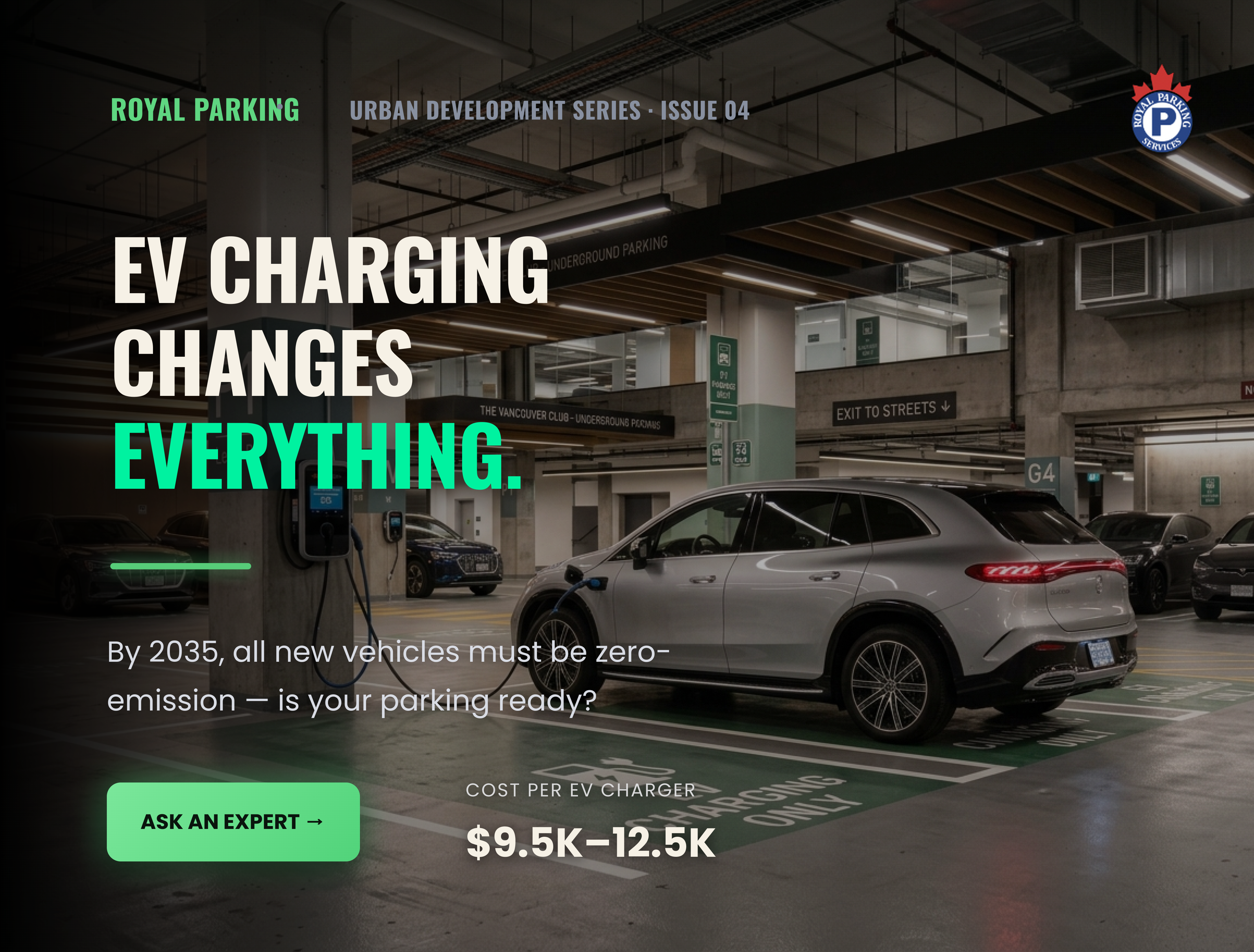
Electric vehicles are no longer a niche product – they’re becoming the standard form of transportation in Canada. The federal government has mandated that all new vehicle sales must be zero-emission vehicles, starting in 2035. Every residential building now being constructed must be ready to accommodate EV owners from day one. This creates an urgent parking problem for property managers and owners who have more demand for stalls but the same number of them.
Table of Contents
The Problem: Every Stall Is Now a Potential Charging Station — and a Liability
EV adoption is increasing faster than most homes were built to accommodate. A recent survey conducted by Pollution Probe in 2024 reported that only 72 percent of the owners of electric vehicles (EV) living in high-rise apartments had access to charging their vehicle at home; which means that approximately one-third of the owners of electric vehicles living in high-rise apartment buildings do not have this option. The financial impact is very significant.
Charging a single EV in a parking space can cost from $9,500 to $12,500.
Toronto has already required all new residential development to include EV ready outlets, so developers have no choice but to plan for the installation of them.
As more residents acquire EV’s, there will be increased demand for available charging spaces while the total number of parking spaces does not increase.
In essence, fewer spaces will be expected to accomplish so much more. Unused or poorly utilized EV stations represents both an economic loss and on going source of conflict among residents competing for the use of those stations.
► EV chargers cost up to $12,500 each to install. Don’t let mismanagement waste that investment. Contact Royal Parking today to get your charging stalls under control. Tap here.
The Royal Parking Solution: Controlling Access When Everyone Wants to Charge
If demand for EV charging exceeds the availability of EV charging stations then a system needs to be developed to determine which users are allowed to use an available charging station, how long they may use it, and enforce the assignment at the site level. This is exactly what royal parking provides.
Designated-stall enforcement – On site patrol ensures that each assigned EV stall is used only by the resident assigned to that stall. Non-EV vehicles cannot block access to EVs.
AppWay Park: Assign, Track Modify – Property Management can assign EV Stalls to residents of the parking area, track all vehicles in real-time, and modify access rights based on changes in demand – All from One Platform.
Scalable as you add more chargers – From 5 stalls to 50 or more, Royal Parking’s systems grow as your EV Infrastructure grows. No re-structuring required.
Clearly Marked Signage at Every Station – All EV charging areas are designed with clear marking so drivers know the rules when entering the lot.
► Don’t let a $12,500 charger sit blocked by the wrong vehicle. Royal Parking enforces your EV stalls so every charger gets used the way it was intended — contact us today. Go here.
Get Your EV Parking Under Control
Royal Parking provides you with the technology, real-time data and the enforcement to remain in front of the increasing electric vehicle (EV) demand for parking at your location. Contact us today so that the conflict does not come to you.
“The Instant High-Rise.” UBC Alumni Magazine, Spring 2026, magazine.alumni.ubc.ca/2026/spring-2026/science-technology/instant-high-rise.
“How Can Canada Fix Its Housing Crisis?” UBC Alumni Magazine, Spring 2026, magazine.alumni.ubc.ca/2026/spring-2026/humanities-life/how-can-canada-fix-its-housing-crisis.
“Zero Emission Vehicles.” Government of Canada, tc.canada.ca/en/road-transportation/innovative-technologies/zero-emission-vehicles.
Pollution Probe. Survey on EV Charging Access in Multi-Unit Residential Buildings. 2024. Cited in Corporate Knights, Dec. 2024, corporateknights.com/transportation/lack-of-charging-stations-in-high-rise-buildings-is-cutting-off-access-to-e vs.


Leave a Reply