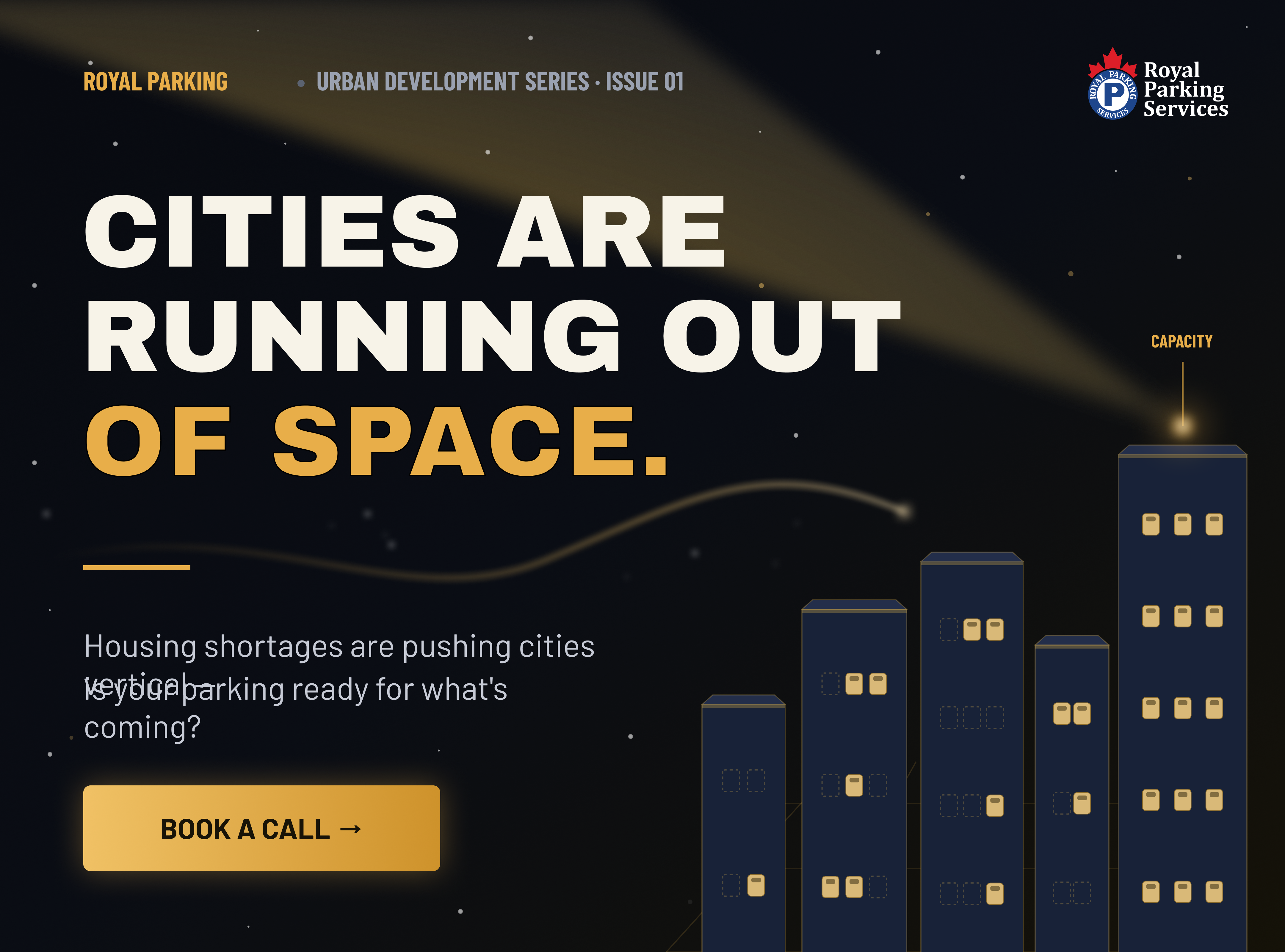
Cities in North America are facing an increasing challenge: there isn’t sufficient housing available to support the demand. The researchers at the University of British Columbia have defined the Canadian housing crisis as the largest urban issue of this generation — it will change the way we think about our cities for many years to come. More high-rise residential units will result in more residents, additional cars and increased pressure on existing parking structures. This is why Royal Parking exists.

Table of Contents
The Big Picture
It has been estimated that the next 25 years could be one of the most impactful periods in the history of urban development. What is happening now indicates the future as follows:
- According to UN projections there will be approximately 1.5 billion more people on earth in the next 25 years.
- It is expected that within the same timeframe (25 years), the world will build and complete more than 2.5 trillion square feet of additional building space. That is equal to one full New York City each month for forty years.
- Approximately 12 percent of Canadian municipalities have “poor” or “very poor” rated municipal infrastructure. This has been estimated to cost anywhere from $250 billion to $260 billion to replace.
- The construction and civil engineering industry generates approximately 38 percent of all of the global greenhouse gas emissions.
- Parking spots can be as expensive as $20,000 or as high as $60,000 in some areas. Therefore, it is imperative that we develop smarter ways to manage our existing spaces.
These numbers are not simply statistical information. These numbers indicate that cities will continue to grow, there will be an increase in buildings and there will be a demand for infrastructure supporting those developments, including parking.
► Don’t wait for the pressure to hit. Talk to Royal Parking now about protecting your property before the next wave of density reaches your building. Tap here.
The Problem: Space Is Running Out
Cities all over North America continue to face a significant challenge when it comes to building sufficient quantities of housing. Housing shortages were exacerbated by the 2008 financial crisis and the COVID-19 pandemic. Each created conditions where less housing was being built while demand continued to increase. The difference between what housing is needed versus available has never been greater than now, according to research from University of British Columbia (UBC).
This is why vertical development or “high-rise” and “high density” construction is becoming an increasingly viable option. Wherever there is a lack of available land, the alternative is to build vertically. Many Canadian urban centers such as Vancouver, Toronto and Calgary are currently experiencing this transition. In addition to other needs associated with the creation of each new tower, there will be an increasing need for organized and professionally-managed parking.
► Your city is already building up. Is your parking system built for what’s coming? Contact Royal Parking today — before your building fills up and the problems start. Click here.

Why This Creates a Parking Crisis
As buildings increase in height and density of residents, it creates the most competition for available parking space:
- The number of residents per building reduces the amount of parking available per vehicle, creating an immediate resource issue.
- Residents are competing with visitors, delivery personnel and contractors for the same limited parking spaces.
- If there is no established process to manage this resource, residents will be engaged in daily disputes and frustration over who has access to which parking space.
- This results in a significant amount of time spent by Property Managers addressing resident’s concerns about parking rather than spending that time doing what is truly important (e.g., managing facilities).
► Parking conflicts don’t fix themselves — they compound. Reach out to Royal Parking now and stop the complaints before they start. Go here.
The Royal Parking Solution: From Chaos to Control, Day One
When a building fills up quickly with no parking system, the problems for property managers begin. Complainants flood their office, rules are never enforced and new residents do not feel confident in their new home. Royal Parking takes care of all those issues, so your management staff can focus on managing your building instead of resolving resident parking complaints.
We provide property managers with an asset they often lack: real power.
- Regular on-site enforcement – enforcement is performed by a schedule, as opposed to enforcement based upon complaints. The problems that arise will be dealt with before they ever get to your desk.
- Consistent rules every day – residents will always know what to expect, which removes the conflict of ambiguous parking rules.
- Digital visitor registration – visitors register through our AppWay Park app using a QR code. No paper work, no phone calls to your office, no one holding up your morning.
- Real time occupancy data – property managers can see who is parked where and for how long at any given time. No more guessing, no more he said she said.
The larger a building becomes, the greater impact a parking system has on whether it functions well or poorly. The result from working with Royal Parking is a well functioning building.
► Your building is filling up. Is your parking ready? Contact Royal Parking before the complaints start — not after. Go here.

Ready to Take Control of Your Parking?
Whether you’re planning to develop a new high-rise or manage an already developed one, Royal Parking has the solutions available to support your parking needs from day one. To learn how we can create the ideal parking management system for your building, contact us today.
► Book a consultation with Royal Parking →
Works Cited
“How Can Canada Fix Its Housing Crisis?” UBC Alumni Magazine, Spring 2026, magazine.alumni.ubc.ca/2026/spring-2026/humanities-life/how-can-canada-fix-its-housing-crisis.
Yang, Y. Infrastructure Canada Research. Cited in UBC Alumni Magazine, Spring 2026.
“Why the Built Environment.” Architecture 2030, architecture2030.org/why-the-built-environment. Source data: International Energy Agency, Global Building Sector CO2 Emissions and Floor Area on the Net Zero Scenario, 2020–2050.
“World Population Prospects.” United Nations Department of Economic and Social Affairs, population.un.org/wpp.
Abbott, Neal T., and Alexander Y. Bigazzi. “Utilizing Shared Parking to Mitigate Imbalanced Supply in a Dense Urban Neighborhood.” Transportation Research Record: Journal of the Transportation Research Board, no. 2651, 2017, pp. 92–100, doi.org/10.3141/2651-10.
Leave a Reply