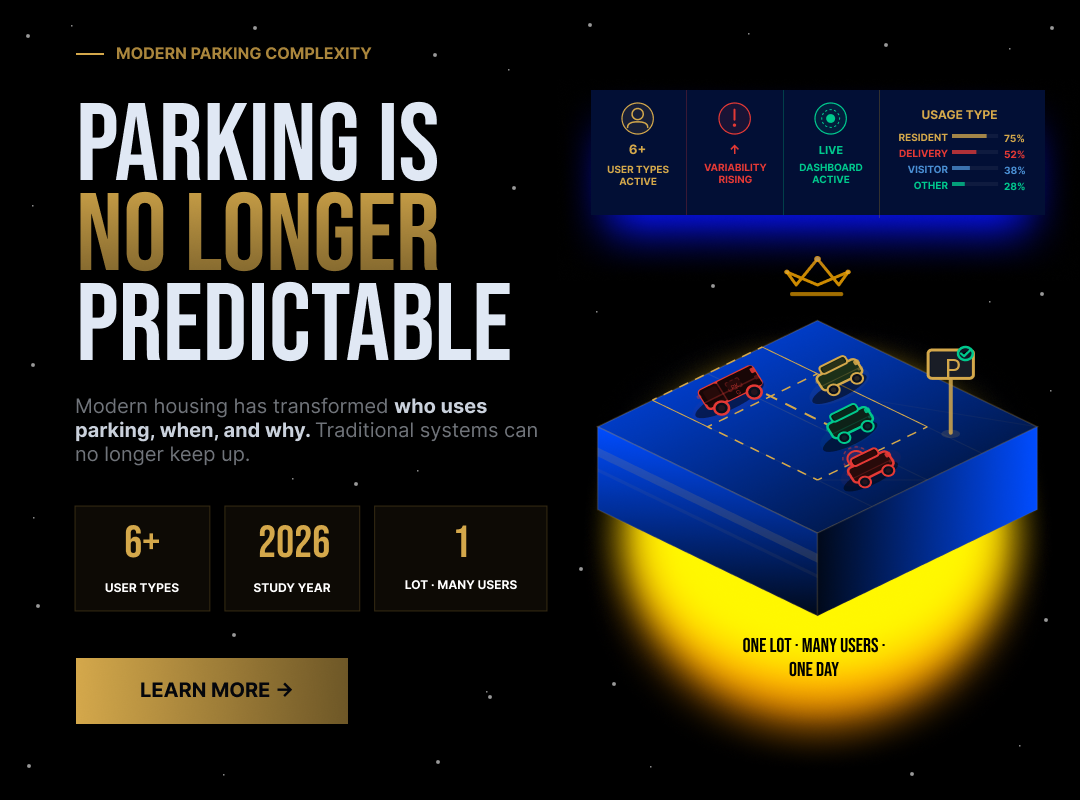
Parking is being used in ways it was never intended to be.
In cities like Vancouver, there has been an increase in shared access. With the advent of ride-hailing and food delivery, and on-demand services (such as Uber Eats, Amazon Prime Now), and flexible housing arrangements; many more individuals are using the same spaces, but at varying times, for different reasons.
With those changes in how spaces are used, parking needs have changed as well.
Where once a parking space was directly associated with one individual, a parking space today exists within a system with continually changing access, time, and utilization.
This blog will outline the challenges facing urban planners when managing parking, due to how individuals interact with parking and how structured management approaches may provide solutions to some of these issues.

Table of Contents
Too Much Choice Creates Frustration, Not Flexibility
Consumer choice has grown dramatically in recent years.
People have an increasing number of options regarding:
- how they travel
- where and how they shop
- how they pay
- how quickly they receive a service
The same desire for consumer choice has been transferred into our built environment.
With the growth of multi-use parking facilities, people expect that there will be various forms of access during different parts of the day (e.g., for delivery, service, short term visitors, etc.) which creates additional opportunities to maximize space usage. However, it also adds another layer to what could become an operational complexity problem.
If there are too many parking options/choices/rules/access, then the user’s ability to easily find and use a parking option becomes harder.
Behavioral Research Concept: Choice Overload
Choice overload was first coined by Barry Schwartz. When individuals are given too many unclear choices:
- The time spent making decisions grows longer.
- Users are less confident about their choices.
- People tend to put off making decisions or make poor ones.
Example
When a driver enters a parking facility, he/she may need to decide if a parking space is:
- Reserved?
- Is registration necessary?
- How long is the parking allowed for my visit?
- Does the parking space apply to my visit?
Unclear choices about parking create “friction” even though parking is available.
The idea
Flexibility is valuable; however, only when the customer understands the simplicity of the system.
Solution
Parking systems should:
- Simplify decisions related to accessing the parking area
- Clearly explain who has access to certain areas
- Provide direction on how best to utilize each parking option.
Provide a parking system that is easy to understand, start with Royal Parking today.
How Royal Parking Makes it Easier
Royal Parking solves the problem of parking complexity by providing clear systems in advance of possible confusion.
For Example:
- Custom signs provided will tell drivers exactly which areas they may and may not park, therefore eliminating the guess work that occurs upon arrival
- Registration via an Appway Park QR code will allow visitors to rapidly register their vehicle as opposed to waiting for a physical permit to be distributed and/or confusing instructions
- Mobile payment options for parking eliminate out-dated parking meters, and provide users with the ability to make payments from their mobile devices
- Regular visits from on site enforcement personnel, will help ensure only registered vehicles are being parked within the designated area
- Digital real time registration provides property management with greater visibility into who is currently parked on the premises and when
As a result, all a driver has to do is follow the same process each time they enter the property; therefore eliminating the need to continually ask themselves:
- “May I park here?”,
- “Do I need a permit?”
- “How many hours am I permitted to remain?”
The system does this for you prior to your arrival.
Make parking easier for every driver who enters your property, upgrade your parking system today. Tap here.

People Tend to be More Motivated by Avoiding Loss (or Problems) Rather than Achieving Gain (Convenience).
While using an efficiently operated parking system will save time, most people will still have questions about the “how to’s”. Questions such as:
- Will I find myself parked in a different spot than assigned?
- Will I get a citation?
- Will there be enough parking at the time of arrival?
- Will another person take advantage of my reserved parking space?
Similar concerns are raised by Property Managers:
- Will unauthorized vehicles continue to take up Visitor Parking spaces?
- Will this cause more Resident Complaints?
- Will enforcement of these rules become even more challenging?
Behavioral Insight (Prospect Theory):
Research has demonstrated that people generally prefer avoiding a bad outcome than pursuing a good one. Prospect theory is the term used to describe this behavioral phenomenon. In layman’s terms, people will usually favor avoiding hassle, ambiguity and possible losses in exchange for having access to a more efficient system.
An example
Visitor Parking System designed to improve operational efficiency. However, if users of the system are unsure of:
- where they can park,
- for how long they can park,
- whether they need to register their vehicle
users will choose to avoid utilizing the improved system. Similarly, Property Managers may delay implementing improvements to the parking operation because they fear that the transition will produce new challenges.
The Insight:
People are reluctant to utilize parking systems if the perceived risks associated with the system outweigh the perceived advantages.
The Solution:
To achieve increased utilization of a parking system, parking operators should attempt to eliminate uncertainty within the system. This can best be achieved through the implementation of:
- clearer procedures,
- defined boundaries,
- consistent enforcement;
- and through a predictable experience.
When parking feels predictable, people are more likely to use it correctly, see how Royal Parking can help. Tap here.
How Royal Parking Makes That Happen
Royal Parking has a reduced level of risk as it:
- makes clear what type of parking will be allowed.
- uses established processes, rules and enforcement measures.
- ensures that there is an equal application of those processes in all interactions.
Using Appway Park, the above structure is supported through:
- Digital Access Control and Registration
- Clearly Defined Permissions to use parking spaces
- Real-Time Visibility on who accesses a space, when, where and for what duration
The combined enforcement and structure of on-the-ground and digital will ensure that parking usage is not open to interpretation.
Parking moves from:
- Uncertain
To:
- Controlled
and Reliable.
Remove parking risks using better enforcement and improved digital tools from Royal Parking. Click here.

The complexity of making parking decisions is increasing
Traditionally, parking systems have been developed using more predictable use patterns.
For example, in many residential developments, there were typically established expectations about how parking would be used:
- Residents had a designated space
- Visitor traffic was generally limited
- The vehicle usage patterns could be easily anticipated (i.e., regular arrival and departure time)
However, these types of usage patterns are becoming less predictable.
Factors influencing the decision-making process regarding parking include:
- Shared houses and/or apartments
- Roommate(s) who own their own cars
- Multi-generational families residing together
- Rental unit turn-over
- Short term visits from friends/family/etc.
- Delivery services
- Service providers (e.g. contractor, repair person etc.)
One parking lot can now support multiple users during the course of a day based upon their respective individual schedules and requirements.
Study Insight
Studies conducted in 2023 on household shared parking decision-making processes indicate that parking decision-making is no longer done solely as an individualized process.
Shared household decision-making is being driven by factors including:
- Household priorities
- Family coordination
- Fairness issues
- Living arrangements (shared or otherwise)
These changes reflect larger changes in how both housing and transportation behaviors are evolving.
Example
Examples of such “parking” usage can be seen in modern condominiums and other multi-family residential dwellings where parking is used for purposes such as:
- Multiple residents in one household
- Separate vehicles owned by roommates
- Visiting family members
- Delivery personnel
- Contractors/repair persons
- Guests arriving at various times throughout the week
And all are interacting with the same parking system.
Predictability is thus reduced due to increased variability.
The Problem
People do not need additional parking; they need a system which can handle unpredictable usage.
With changing housing patterns and visitor traffic, delivery services and shared living arrangements, more individuals are utilizing the same parking spaces at different times for different purposes.
Therefore, the current parking system must now accommodate increased variability-not just more vehicles.
Solution
To meet this new reality, parking systems must be able to:
- provide clear access procedures.
- coordinate use of spaces.
- be managed.
Modern living demands that parking systems be upgraded.
How Royal Parking Solved This Problem
With parking becoming less predictable, owners and management require systems capable of accommodating changed demand for parking in a manner that does not create additional confusion to the residents.
Royal Parking provides solutions to these issues by providing clarity for residents about access to parking and when it is available.
Examples of ways we provide clear structure include:
- Visitors may use Appway Park’s QR registration system for vehicle registration rather than calling management or obtaining an in-paper permit;
- Delivery personnel and other service providers are routed to designated parking areas where they should park (not occupy residential spaces);
- Residents have better clarity regarding parking rules and regulations which will assist in reducing resident confusion;
- Routine enforcement assists in ensuring that reserved spaces are being utilized as intended.
For Property Managers, this will result in:
- Fewer resident complaints
- Less unauthorized parking
- Reduced administrative back-and-forth regarding daily parking issues
Rather than requiring staff to continually manage changing demands for parking space utilization, Royal Parking offers a scalable system to accommodate how people are living today. Tap here to learn more.

Conclusion: Parking is Changing More Quickly than Many Systems Were Designed for
Parking’s greatest challenge is no longer a matter of available parking spaces, it is providing a means by which individuals can adapt their daily routines to how they live, travel, and make decisions in today’s world.
New Expectations for Parking Systems. Parking systems should now provide services to:
- more diverse types of household usage (i.e., non-traditional usage)
- multiple visitors per day/week/month
- delivery vehicles and personnel
- service providers (e.g., food delivery drivers)
- new, shared-access usage patterns
Users now expect a simple process to navigate a parking system.
Additionally, users now also want to have a simple process to find parking, trust where they parked, and know what to do next. When those expectations are met:
- The user finds it easier to decide whether or not to participate
- Participation increases
- Operational issues decrease (or disappear).
Bottom Line
If you have ample parking space, your parking system may still fail as a result of poor design.
To remain competitive in the rapidly changing environment of parking systems, property owners need to develop new, “smarter” systems that will address modern usage patterns and provide:
- Clarity
- Coordination
- Predictability
Of all the companies assisting with this transition, Royal Parking offers solutions through structured enforcement, clear access systems, and digital tools such as Appway Park.
In doing so, Royal Parking assists with turning parking from an operational frustration to a simpler, more efficient, and reliable experience.
Glossary
Choice Overload
When people are given too many options, making it harder for them to decide what to do.
Prospect Theory
A concept in behavioral science that explains how people make decisions based on avoiding loss rather than gaining benefits.
Shared Parking
A system where the same parking space is used by different people at different times instead of being assigned to one user.
Parking System
The overall way parking is managed, including rules, access, enforcement, and how spaces are used.
Access
The ability for someone to use a parking space based on rules or permissions.
Parking Utilization
How often parking spaces are actually used instead of sitting empty.
Uncertainty
When users are unsure about parking rules, availability, or outcomes.
Variable Parking Demand When parking needs change throughout the day due to different users, schedules, and transportation habits.
Household Parking Coordination The process of multiple people within a household managing access to limited parking spaces.
Access Control Rules or systems that determine who can park in certain spaces and when.
Enforcement
The process of making sure parking rules are followed.
Structured Parking Management
A system where parking is clearly organized with defined rules, controlled access, and consistent enforcement.
Digital Access Control
Using technology (like Appway Park) to manage who can park, where, and when.
References
Schwartz, Barry. The Paradox of Choice: Why More Is Less. Harper Perennial, 2004.
https://www.harpercollins.com/products/the-paradox-of-choice-barry-schwartz
Kahneman, Daniel, and Amos Tversky. “Prospect Theory: An Analysis of Decision under Risk.” Econometrica, vol. 47, no. 2, 1979, pp. 263–291.
https://www.jstor.org/stable/1914185
Xue, Yunqiang, et al. “Shared Parking Decision Behavior of Parking Space Owners and Car Travelers Based on Prospect Theory—A Case Study of Nanchang City, China.” Sustainability, vol. 14, no. 24, 2022.
https://doi.org/10.3390/su142416877
Liu, Panyu, et al. “A Model of Household Shared Parking Decisions Considering Parking Space Allocation.” Transportation Research Part A: Policy and Practice, vol. 172, 2023. https://www.sciencedirect.com/science/article/pii/S0965856423000058
Leave a Reply